
160 읽음
Why the U.S. Ambassador’s Mother Never Ate Eggplant Again
 최보식의언론
 0
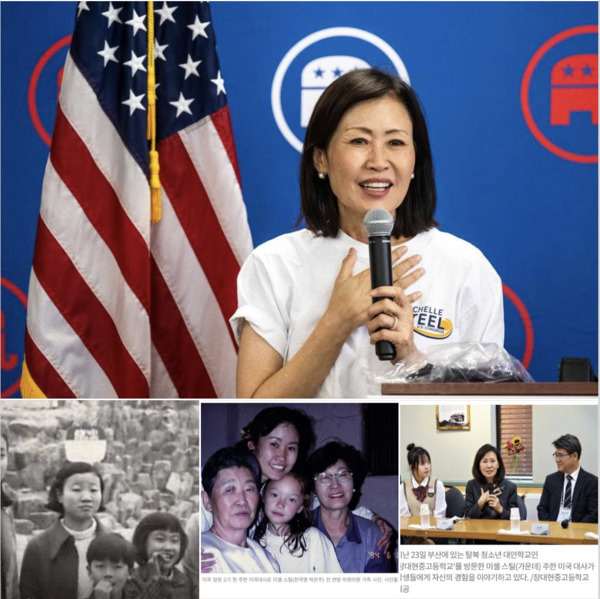
The daughter of parents who fled North Korea during the Korean War, Steel encouraged the students by sharing her immigration experience.
“My parents also escaped from North Korea, so I come from the same background as you,” she told them.
Steel, who lived in Japan because of her father’s diplomatic work and studied English literature there, also spoke about the language barriers she encountered in Japan, emphasizing that “foreign-language skills become a great asset for the future.”
She answered students’ questions directly in Korean and English and encouraged them to participate in cultural and educational exchange programs offered by the U.S. Embassy.
Founded in 2014, Jangdaehyeon Middle and High School is the only alternative school for North Korean defector youth in the Yeongnam region of southeastern South Korea.
Steel was born in Seoul in 1955 and moved to the United States in 1975. Her parents were displaced North Koreans who escaped to Busan during the Korean War.
Steel’s mother reportedly never cooked eggplant because she had hidden in an eggplant field while fleeing south to escape the communists.
The following is an account of Ambassador Steel’s life story compiled by Noh Seok-jo, a reporter for the Chosun Ilbo, and posted on his personal social media account under the title, “Why U.S. Ambassador Michelle Steel’s Mother Never Ate Eggplant in Her Life.” (Editor’s note)
Michelle Steel’s mother reportedly never ate eggplant throughout her life. Nor did she ever cook an eggplant dish at home while her daughter was growing up.
It was not because she disliked its taste or smell. It was because of memories of escaping from North Korea during the Korean War.
In a 2021 interview with the American women’s organization Independent Women’s Forum, Steel described her mother’s escape in detail.
After reading that story, Steel’s visit to a school for North Korean defector youth in Busan on October 23 took on a somewhat different meaning.
That day, Steel spent an hour and a half eating lunch and talking with North Korean defector students at Jangdaehyeon Middle and High School in Busan.
“My parents were also from North Korea. Like you, I have lived my life as the child of parents who escaped from North Korea.”
Steel told the students about the difficulties she experienced with language while attending school in Japan and about her experiences in the United States.
She encouraged them to visit America, learn the languages of different countries, and broaden their horizons.
There is a particularly personal reason why Steel visited the North Korean defector students in Busan.
Busan is where her parents, having fled North Korea, met each other more than 70 years ago.
Steel’s mother, Jung Ok-hee, was from Sinuiju, North Pyongan Province. Her father also came from a family of displaced people with roots in North Korea, although he himself was born in Shanghai, China.
Her maternal family was involved in the lumber business in North Korea. Her maternal great-grandfather operated a lumber business, and her maternal grandfather helped with the work.
But the family’s fate changed when a communist regime came to power in North Korea.
According to Steel’s account in her 2021 interview, her maternal grandfather was ordered by the authorities to leave his home within 24 hours. The family was permitted to take only what could fit on one horse and one cart.
They gathered cooking pots, rice, and other immediate necessities and left home.
The journey south was treacherous. Steel’s mother, who was looking after her younger siblings, had to hide in an eggplant field to avoid being discovered.
It was pitch-dark, and the children cried. If the cries of the young children were heard outside, the entire family could be in danger. Whenever her younger siblings cried, their mother had to cover their mouths to keep them quiet.
The family also paid a guide and traveled by boat.
On one occasion, a train was so crowded that they had to place her younger sister on the roof. The sister was only three years old at the time, and Steel’s mother had to make sure other passengers were holding her so she would not fall.
Eventually, the family made its way south and arrived in Busan.
Her mother never forgot the time she spent hiding in the eggplant field.
Steel explained why her mother never cooked eggplant at home:
“My mother hid in an eggplant field, so she never cooked eggplant for the rest of her life. She said she would never eat that vegetable again.”
The eggplant field had been a hiding place that saved their lives. But it was also a place where she had endured the terror of possibly being discovered at any moment while caring for her younger siblings.
After arriving in Busan, Steel’s mother met and married a man who was also a displaced person from North Korea.
Their daughter, born in Seoul on June 21, 1955, was Michelle Steel.
Steel was born in Seoul but spent much of her childhood and adolescence in Japan.
Her father had been assigned to Japan for work related to diplomacy, and the family moved there together.
She attended middle and high school in Japan. As a Korean living in Japanese society, she experienced differences in language and culture.
After graduating from high school, she entered a Japanese university and majored in English.
It was there that an important turning point came in her life.
About a year after she entered university, her father heard her English pronunciation and advised her to go to the United States to study.
Steel recalled the experience:
“I finished one year of college in Japan, and English was my major. But I was speaking English with a Japanese accent. My father wanted me to become a diplomat. So he told me that if I wanted to learn proper English, I had to go to America.”
Her father sent his daughter to the United States ahead of the rest of the family.
In 1975, at the age of 20, Steel left her university studies in Japan and moved to America.
Steel is often described as having immigrated to the United States with her family in 1975, but the story she told herself is somewhat different.
Steel went to America first. Relatives, including an aunt and her maternal grandmother, had already moved there.
Three years later, in 1978, her father died, and her mother and other family members moved to the United States to join her.
Steel continued her education in America. She studied business administration at Pepperdine University in California. According to the university’s official records, she received her bachelor’s degree in 1997.
She later completed a Master of Business Administration (MBA) program at the University of Southern California (USC). Her official U.S. House of Representatives biography records that she earned her MBA in 2010.
Although she had majored in English in Japan, she studied business administration in the United States, earning both bachelor’s and master’s degrees.
Life in America was not easy from the beginning.
Her mother opened a men’s clothing store in Los Angeles. To help her mother, who was not comfortable speaking English, Steel worked at the store while studying.
She reportedly handled everything from purchasing merchandise and selling it to customers to hiring and firing employees.
She later recalled that she had been the store’s buyer, salesperson, and employee manager.
Running the store with her mother gave her firsthand experience of the difficulties faced by small-business owners in America.
That experience would later become an important asset in her political career.
One of the direct reasons Steel entered American politics was a tax bill sent to her mother.
Her mother, who operated a store in California, one day received a notice from state tax authorities demanding payment of a substantial amount.
But the tax had been incorrectly assessed.
Her mother, whose English was limited and who was unfamiliar with American administrative procedures, was unable to challenge the authorities.
In the end, she paid taxes she did not owe, along with penalties and interest.
Steel said she was shocked when she later learned what had happened.
In her 2021 interview, she explained that tax notices from government authorities could be a source of fear for first-generation immigrants who did not speak English well.
She came to understand how immigrants unfamiliar with the American system could be subjected to incorrect administrative decisions without being able to protest effectively.
The 1992 Los Angeles riots also influenced her political involvement.
Koreatown suffered extensive damage during the riots. Numerous Korean-owned businesses were looted and burned.
It was a period when awareness was growing that, although the Korean American community had established itself economically, it lacked sufficient political power to defend its interests.
The following year, in 1993, Steel joined the campaign of Richard Riordan, a Republican candidate for mayor of Los Angeles.
Riordan won the election, and Steel subsequently gained experience serving on various Los Angeles city commissions.
She became an elected politician in 2006.
She ran for and won a seat on California’s State Board of Equalization.
The board was involved in state tax assessment and collection. In that sense, her mother’s experience of being unable to challenge an incorrect tax bill led Steel into the field of tax administration.
While serving on the board, Steel challenged a system that imposed excessive security deposits on small businesses.
The system required people starting businesses to deposit between $5,000 and $50,000.
She explained that she spent years working to abolish the requirement and return the deposits to taxpayers.
Steel met her future husband, Shawn Steel, on a tennis court at the Ambassador Hotel in Los Angeles.
Shawn Steel was an American attorney deeply involved in Republican politics.
Her mother initially opposed the marriage, reportedly because marriage to a white American man was uncommon in the Korean American community at the time.
Steel recalled that her mother’s opposition was considerable, but her maternal grandmother intervened and persuaded her to accept the marriage.
The couple married in 1981 and later had two daughters.
Shawn Steel served as chairman of the California Republican Party and has been a member of the Republican National Committee since 2008.
After winning election to the State Board of Equalization in 2006, Michelle Steel was elected an Orange County supervisor in 2014. She won reelection in 2018.
In 2020, she finally ran for the U.S. House of Representatives.
She defeated Democratic incumbent Harley Rouda in California’s 48th Congressional District.
In the same election, Steel, Young Kim, and Marilyn Strickland became the first Korean American women elected to the U.S. House of Representatives.
Following redistricting, she won reelection in the 45th Congressional District in 2022.
In Congress, she focused not only on taxes and small-business issues but also on North Korean human rights, U.S.–China relations, and security cooperation among South Korea, the United States, and Japan.
Her parents’ experiences escaping North Korea also influenced her political views.
In her 2021 interview, she expressed concern about some younger Americans viewing socialism favorably, referring to North Korea and China.
She also expressed gratitude that she had been able to become an American citizen and eventually win election to Congress.
She was active on North Korean human rights issues and participated in legislation supporting reunions for Korean Americans separated from family members in North Korea.
However, she lost her bid for a third term in Congress in November 2024 to Democratic candidate Derek Tran.
The margin was just 653 votes.
Tran received 158,264 votes, while Steel received 157,611. In an election involving approximately 316,000 voters, the outcome was decided by a margin of about 0.21 percentage points.
Her four years in Congress thus came to an end.
Another turning point in her political career arrived in 2026.
President Donald Trump nominated her as U.S. ambassador to South Korea in April.
On June 17, the U.S. Senate confirmed her appointment by a vote of 55 to 39.
She became the second Korean American to serve as U.S. ambassador to South Korea, following former Ambassador Sung Kim, and the first Korean American woman to hold the position.
Another interesting episode in Steel’s family history concerns her mother’s belated university graduation.
Her mother, Jung Ok-hee, entered the Department of Korean Language and Literature at Ewha Womans University in 1951.
However, the aftermath of the war prevented her from properly completing her studies.
She subsequently married, raised children, and immigrated to the United States, where she also worked as an essayist.
Then, in 2003, Ewha Womans University abolished its so-called marriage prohibition rule, which had barred female students from marrying while enrolled. This opened a path for Jung to resume her education.
At the age of 74, she returned to school.
In February 2004, she finally received her diploma.
It had been 53 years since she first enrolled in 1951.
A woman who had fled North Korea, met her husband in Busan, given birth to children in Seoul, and immigrated to America returned to a Korean university in her seventies to complete her education.
Steel personally shared this story in August this year while introducing Habib House, the U.S. ambassador’s residence in South Korea.
In the video introducing the residence, she showed photographs of her parents and spoke about the sacrifices of Korean War veterans and the importance of South Korea–U.S. relations.
Her mother carried the memory of hiding silently in an eggplant field during the war throughout her life.
Yet in her later years, she resumed the studies she had been unable to finish in her youth.
Her mother’s own life was a remarkable journey as she watched her daughter move to America, study, help run a business, and become a politician.
Steel arrived in South Korea on July 30 to take up her position as U.S. ambassador.
The first place she visited that day was Youngnak Presbyterian Church in central Seoul.
The church was founded in 1945 by the Rev. Han Kyung-chik and Christians who had come south from North Korea.
Steel’s parents had also attended the church while living in Korea.
Steel wrote in the church guestbook that she was pleased to begin her new journey in Korea with prayer.
She later attended Sunday worship with her husband.
Before beginning her official duties as U.S. ambassador, she visited the church her parents had attended.
Three months later, on October 23, she visited Jangdaehyeon Middle and High School in Busan.
The school, established in 2014, is an alternative school for North Korean defector youth.
It has a student capacity of 20, and all students live in dormitories.
A native English-speaking teacher assigned through the Fulbright Foundation, supported by the South Korean and U.S. governments, teaches English there.
The students have varied backgrounds. Some were born in North Korea, while others were born in China and are not fluent in Korean.
Over lunch, Steel told the students about her childhood and adolescence.
She spoke about the difficulties of adapting to an unfamiliar language and culture while attending school in Japan, and about her experience of moving to America, learning English, pursuing her education, and building a new life.
When students asked questions in English, she answered in English. When they asked in Korean, she replied in Korean. She communicated through an interpreter with students who asked questions in Chinese.
She told them that learning several languages could become a valuable asset in the future and encouraged them to participate in the U.S. Embassy’s cultural and educational exchange programs.
A Korean student who once majored in English in Japan went to the United States at her father’s suggestion.
There, she graduated from university, entered business and politics, and became a member of Congress.
Now she has returned to Korea as the U.S. ambassador.
Steel is a diplomat representing American national interests.
As a former Republican politician, she also holds clear political positions on North Korea and China.
Her diplomatic activities will be judged according to the specific issues between South Korea and the United States and the policies of the U.S. government.
Nevertheless, her visit to Busan brings her family history back to mind.
More than 70 years ago, her mother escaped from North Korea while caring for her younger siblings.
At night, they had to hide in an eggplant field, and they encountered danger repeatedly before reaching Busan.
Now that mother’s daughter has returned as the U.S. ambassador and sat down with young North Korean defectors in Busan.
As she shared her experiences with the students, perhaps she also recalled the stories of her mother’s escape that she had heard throughout her life.
The very city where she shared lunch with the students was the city where her parents had begun a new life many years earlier.
June 21, 1955
Born in Seoul. Korean name: Park Eun-joo. Her parents were displaced people who had come south from North Korea.
1960s–Early 1970s
Grew up in Japan because of her father’s work. Attended middle and high school in Japan, then entered university, where she majored in English and studied for one year.
1975
Went to the United States to study at age 20 on her father’s advice, leaving her university studies in Japan.
1978
Her father died. Her mother and other family members moved to the United States to join her. She subsequently helped operate her mother’s men’s clothing store in California.
1981
Married Shawn Steel, an American attorney and Republican politician. They later had two daughters.
1992
The Los Angeles riots made her acutely aware of the Korean American community’s lack of political influence and sparked her interest in political activity.
1993
Became actively involved in politics by participating in Richard Riordan’s campaign for mayor of Los Angeles.
1990s
Gained public-service experience through work on Los Angeles city commissions and other bodies.
1997
Received a bachelor’s degree in business administration from Pepperdine University.
November 2006
Elected to California’s State Board of Equalization. Took office in 2007.
2010
Received an MBA from the University of Southern California.
November 2014
Elected Orange County supervisor in California. Took office in 2015.
2018
Reelected Orange County supervisor.
November 2020
Elected to the U.S. House of Representatives from California’s 48th Congressional District, becoming one of the first Korean American women to serve in Congress.
November 2022
Reelected to the U.S. House from the 45th Congressional District following redistricting.
November 2024
Lost her bid for a third term in Congress to Democrat Derek Tran by 653 votes, a margin of approximately 0.21 percentage points.
April 13, 2026
Nominated by President Donald Trump as U.S. ambassador to South Korea.
June 17, 2026
Confirmed by the U.S. Senate in a 55–39 vote.
July 30, 2026
Arrived in South Korea as U.S. ambassador and visited Youngnak Presbyterian Church in Seoul, which her parents had attended.
August 4, 2026
Submitted a copy of her credentials to the Foreign Ministry and met Foreign Minister Cho Hyun.
August 12, 2026
Presented her credentials to President Lee Jae-myung.
October 22, 2026
Visited Busan City Hall and participated in activities related to South Korea–U.S. cooperation.
October 23, 2026
Visited Jangdaehyeon Middle and High School in Busan, where she had lunch with North Korean defector students and shared her parents’ escape experiences and her own upbringing.
Based on publicly available information as of October 2026.
Birthplace: Sinuiju, North Pyongan Province.
Education: Attended Unjeong Elementary School and Nam Girls’ High School in Sinuiju before fleeing south. Graduated from Jungang Girls’ High School in Seoul. Graduated from the Department of Korean Language and Literature at Ewha Womans University and earned a master’s degree in language education from Ewha’s Graduate School of Education.
Occupations: Korean-language teacher, Korean American essayist, and clothing business owner.
Career: Korean-language teacher at Jungang Girls’ Middle and High School; Korean-language teacher at a Korean school in Tokyo; leader in the Girl Scouts of Korea; and chairwoman of the Korean American Literary Association, among other positions.
Life in America: Immigrated to the United States in the late 1970s and operated a men’s clothing store in Los Angeles. Received assistance from her eldest daughter, Michelle, because she was not comfortable speaking English.
Notable detail: Entered Ewha Womans University in 1951 but interrupted her studies because of the war, marriage, and other circumstances. Graduated in 2004, 53 years after first enrolling.
Major books: The Village With Eucalyptus Trees, The Women of Rolling Hills, The Village on the Hill, Because I Could Not Help Loving, I Staked My Life on a Purple Branch (2008), and Flowers Bloomed Even Amid War (2010). These are English translations of the Korean titles.
In particular, I Staked My Life on a Purple Branch is a memoir documenting her experiences as a refugee during the Korean War. It includes a chapter titled “Surviving on Eggplant.”
Birth: Shanghai, China. His family’s ancestral home was in South Pyongan Province.
Occupation: Educator and worker in overseas education and cultural affairs.
Career: Reportedly worked as an English teacher in Korea and later at an institution involved in Korean education and culture in Osaka, Japan.
Education: Specific university education unconfirmed.
Family history: Came south around the time of the Korean War, met Jung Ok-hee in Busan, and married her.
Notable detail: Hoped his eldest daughter, Michelle, would become a diplomat and sent her to the United States in 1975 to learn English properly.
Origin: Sinuiju area, North Pyongan Province.
Occupation: Lumber-related business.
Family history: His father operated a lumber business, and he participated in the family enterprise. When the communist regime came to power in North Korea, the family lost its property and fled south.
Education: Unconfirmed.
Origin: A displaced family from North Korea.
Education and occupation: Unconfirmed.
Immigration to America: Moved to the United States at the invitation of a daughter who had settled there around the early 1970s. Lived in the Washington, D.C., area, including Silver Spring, Maryland.
Notable detail: When Michelle wanted to marry Shawn Steel, her mother, Jung Ok-hee, opposed the marriage, but her maternal grandmother reportedly persuaded her to accept it.
Birth: Around 1946, California, United States.
Education: Bachelor’s degree from California State University, Northridge (CSUN); master’s degree in history from the University of Southern California; and Juris Doctor (JD) from Northrop University.
Occupation: Attorney and Republican politician.
Career: Chairman of the California Republican Party (2001–2003); California representative to the Republican National Committee since 2008.
Political activities: Involved in American conservative politics since Barry Goldwater’s 1964 presidential campaign. Also participated in the 2003 recall campaign against Democratic California Gov. Gray Davis.
Family: Married Michelle Steel in 1981. They have two daughters.
Education: Attended the University of Southern California.
Occupation: Former congressional staff member with experience in political communications.
Career: Chairwoman of a California college Republican organization; White House intern during the George W. Bush administration; staff member in the office of Rep. Joseph Cao; and communications work for the House Oversight and Government Reform Committee and a Senate committee dealing with small-business issues.
Family: Married Mr. Klotz and has children.
Current occupation: Unconfirmed.
Education: Bachelor’s degree from Vanderbilt University and a Master of Science in Security Studies from Georgetown University.
Occupation: Foreign-policy, security, and homeland-security specialist.
Career: Worked at the U.S. Department of Homeland Security (2017–2025), including assignments involving Latin America and the Caribbean in the Office of International Affairs, intelligence analysis of transnational organized crime, and strategic counterterrorism analysis.
Private-sector experience: Chief of Staff at BMNT Ltd, a defense innovation consulting firm based in London.
Activities in 2026: Researcher in the Transatlantic Security and Defense Program at the Center for European Policy Analysis (CEPA), and a Robert Belfer International Affairs Fellow at the Council on Foreign Relations (CFR).
Research interests: European security, NATO, and U.S.–European defense cooperation.
Relationship: Jung Ok-hee’s second daughter and Michelle Steel’s younger sister.
Education and occupation: Not confirmed in publicly available sources.
Family: Listed as having two sons in her mother’s 2010 author biography.
Relationship: Jung Ok-hee’s third daughter and Michelle Steel’s youngest sister.
Education and occupation: Not confirmed in publicly available sources.
Family: Her husband is described as a dentist. His name and other details remain unconfirmed.
Maternal great-grandfather: Operated a lumber business in North Korea. Name unconfirmed.
Fourth maternal aunt: According to Ambassador Steel, settled in the United States with her husband around 1970 and subsequently invited Steel’s maternal grandmother to America. Name unconfirmed.
Paternal grandparents: Steel’s father was reportedly born in Shanghai, China, to Korean immigrant parents, but their names and careers are unconfirmed.
Grandchildren: Ambassador Steel and her husband have four grandchildren.
#MichelleSteel #NorthKoreanRefugees #KoreanWar
* This article has been translated by ChatGPT.