
326 읽음
South Korea’s Former Finance Chief Allegedly Fired Over $114 Billion Fund Dispute
 최보식의언론
 0
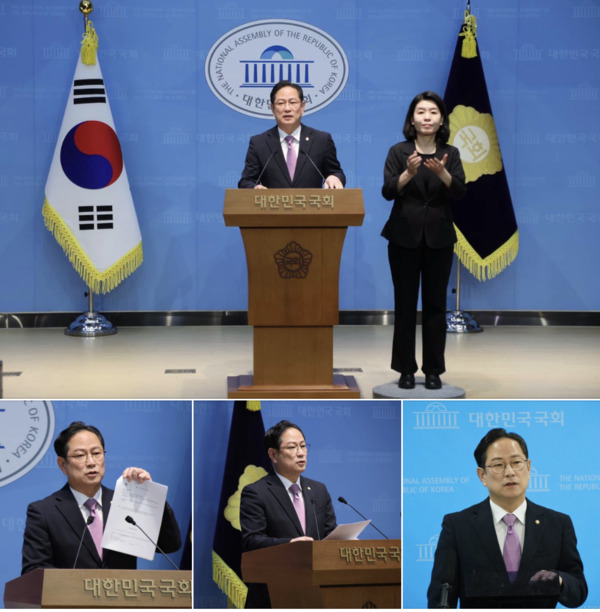
Rep. Park Soo-young of the People Power Party held a press conference on October 22 and claimed that Koo had been dismissed at the airport because he had submitted proposed revisions to the 162 trillion won Future Response Fund Bill, which the Ministry of Planning and Budget allegedly intended to turn into a “slush fund for the administration.”
Park said, “Former Deputy Prime Minister Koo submitted 10 requests for deletions and revisions to the Future Response Fund Bill, but not a single word was reflected.”
“The Ministry of Planning and Budget, headed by politician Park Hong-keun, defied the Ministry of Economy and Finance, headed by the Deputy Prime Minister for Economic Affairs,” he said.
“Three days after submitting his objections, Deputy Prime Minister Koo was notified of his dismissal at the airport as he was about to leave the country,” Park added.
The following is the full text of Rep. Park's press conference statement, titled “Ministry of Planning and Budget Disregarded All 10 Recommendations from the Ministry of Economy and Finance.” — Editor
The 162 trillion won Future Response Fund being pushed forward by the Lee Jae-myung administration was a “monster of unilateral decision-making” created by the Ministry of Planning and Budget, which hastily pursued the proposal while disregarding every request by the Deputy Prime Minister for Economic Affairs to delete or revise its provisions.
The administration abandoned procedural legitimacy, under which disagreements between ministries during the legislative notice period should be resolved through coordination or postponement.
Moreover, even the desperate appeals posted by career civil servants on the Ministry of Economy and Finance's internal bulletin board, who put their careers on the line, were ignored.
I will now disclose, for the first time, the Ministry of Economy and Finance's requests for deletions and revisions to the legislation, which I have obtained, along with an appeal posted by a young civil servant on the ministry's internal bulletin board.
On August 27, the Ministry of Economy and Finance submitted its review comments on the proposed Act on the Establishment and Operation of the Future Response Fund (the Future Response Fund Act) and the proposed amendment to the National Finance Act, following a request from the Ministry of Planning and Budget on August 25.
The Ministry of Economy and Finance requested the deletion of seven provisions from the Future Response Fund Act and revisions to three provisions of the proposed amendment to the National Finance Act.
However, not a single word of these requests from the Ministry of Economy and Finance, headed by the Deputy Prime Minister for Economic Affairs, was accepted by the Ministry of Planning and Budget, headed by a politician serving as minister.
The Ministry of Economy and Finance's greatest concern was the provision concerning the Future Response Fund's surplus resources.
The Ministry of Planning and Budget had created a mechanism allowing the Future Response Fund to deposit surplus resources directly into other funds and accounts, or directly receive surplus resources from other funds, without going through the Public Capital Management Fund.
The intention was to turn it into the administration's own slush fund.
However, the Ministry of Economy and Finance demanded that all relevant provisions be deleted if the Future Response Fund was to function as a fiscal stabilization mechanism.
Because the proposal would fundamentally undermine the fiscal management system centered on the Public Capital Management Fund, which has traditionally managed the surplus resources of various government funds on a consolidated basis, the Ministry of Economy and Finance's demand was entirely reasonable.
Nevertheless, all seven requests for deletion were disregarded by the Ministry of Planning and Budget.
In reviewing the proposed amendment to the National Finance Act, the Ministry of Economy and Finance also sought to clearly stipulate that resources from the Future Response Fund could be used to repay government bonds.
This was a legitimate position based on the principle that excess tax revenues should first be used to repay national debt under the National Finance Act.
However, this recommendation was not reflected at all.
The Ministry of Economy and Finance also proposed designating its minister as the authority responsible for the use of excess tax revenues, in order to prevent the Ministry of Planning and Budget from using such revenues indiscriminately.
This recommendation was likewise disregarded.
As the situation deteriorated, a heartfelt appeal titled “Please Speak Up for a Genuine Response to the Future”appeared on August 28 on Empathy and Communication, the Ministry of Economy and Finance's internal bulletin board.
Yet this appeal, too, was ignored.
I will now read its contents.
“The Future Response Fund that the Ministry of Planning and Budget seeks to establish is a system intended to accumulate additional tax revenues generated during periods of strong tax collection in a separate fund, rather than allocating them first to national debt repayment and other obligations, in preparation for future structural changes.
However, contrary to its stated justification, it is nothing more than a stopgap measure that disregards the fundamental principles of public finance and shifts the burden onto future generations.
Medium- and long-term macroeconomic management, the issuance and repayment of government bonds, and the rules governing the disposition of the general account surplus under the National Finance Act are the exclusive authority and responsibility of the Deputy Prime Minister for Economic Affairs.
Deputy Prime Minister, please do not stand by while our economy's balance sheet is damaged. Please speak up for young people.
The Future Response Fund proposes to establish arbitrary criteria, such as a 10-year trend line, and even invents an artificial concept of ‘additional tax revenue’ to collect and accumulate taxes during periods of economic prosperity.
This can only be interpreted as an attempt to circumvent the fiscal rules established by the Constitution and laws—including fiscal soundness requirements and procedures for handling the general account surplus—and to escape parliamentary oversight.
From the perspectives of finance and public finance, the optimal management of national finances is to ‘repay debt first, and, when necessary, prepare supplementary budgets and issue government bonds.’
If excess tax revenues are used immediately to repay government bonds rather than being accumulated in a fund, interest expenses are reduced with certainty.
When a crisis occurs or resources are needed to prepare for the future, the procedures for securing fiscal flexibility under the National Finance Act can be followed.
Ultimately, it is today's young people and future generations who will have to bear the unnecessarily wasted interest costs on government debt.
The fund's name also distorts its true nature.
Genuine preparation for the future requires creating a sound, sustainable fiscal structure and sufficient fiscal capacity without passing future burdens onto the next generation.
Repaying government debt and stabilizing an uncertain pension system are what genuine preparation for the future means.
A fund that begins by considering how to spend money is not a Future Response Fund but merely a ‘Future Extinction Fund.’
As the last line of defense protecting the soundness of national finances, strict financial control is the unique responsibility of our ministry.
Rather than silently going along with the proposal, please demonstrate a responsible attitude in defending what young people regard as genuine preparation for the future and the fundamental principles of the National Finance Act.”
Comments posted in response included remarks such as “Is paying off the national debt a foolish thing to do?” and “It will leave deep scars, just like the Samsung Electronics and SK Hynix ETFs.”
One comment even expressed concern about being silenced, warning, “Be careful, as the oversight committee is active.”
No one in the Lee Jae-myung administration listened to these desperate appeals from civil servants.
Instead, the administration moved with extraordinary speed.
On August 30, just three days after Deputy Prime Minister Koo Yun-cheol requested revisions, he was notified of his dismissal at the airport while on his way to the United States for an official trip.
Two days later, on September 1, the Future Response Fund Act passed the Cabinet in the form advocated by the Ministry of Planning and Budget.
This was just one week after the legislative notice was issued on August 24.
I ask the Lee Jae-myung administration:
Why did you create a “Future Extinction Fund” that shifts every burden onto future generations?
Are excess tax revenues the administration's political funds?
Is it acceptable for the Minister of Planning and Budget, a former politician, to commit an act of insubordination by trampling on the warnings of his superior, the Deputy Prime Minister for Economic Affairs?
Did the President dismiss the Deputy Prime Minister who opposed the Future Response Fund and adopt the Ministry of Planning and Budget's proposal in order to turn national finances into the administration's own slush fund?
I urge the Lee Jae-myung administration to act.
The Ministry of Planning and Budget must transparently disclose why it rejected all 10 official requests from the Ministry of Economy and Finance and how those decisions were made.
It must also disclose what it reported to the presidential office regarding the Future Response Fund and what instructions it received.
The new Deputy Prime Minister for Economic Affairs, Lee Hyung-il, must also speak up properly.
Is the Ministry of Economy and Finance a subordinate agency of the Ministry of Planning and Budget?
I also make the following demand of the Democratic Party of Korea:
Let us reconsider the Future Response Fund, on which the future of the Republic of Korea depends, from the very beginning.
I also appeal to the Speaker of the National Assembly.
Please do not designate the proposed Future Response Fund Act and the proposed amendment to the National Finance Act as budget-related bills.
A fund worth 162 trillion won must not be automatically placed before the National Assembly's plenary session and passed without proper scrutiny simply because of a legislative review deadline.
Finally, I make this demand of President Lee Jae-myung:
Withdraw the Future Response Fund in its entirety. It threatens to destroy the future of our young people.
That is the minimum responsibility you owe to future generations.
#SouthKorea #KooYunCheol #GovernmentSpending
* This article has been translated by ChatGPT.