
456 읽음
“It’s Just a Movie”... Why Director Hur Jin-ho Is Cowardly
 최보식의언론
 0
0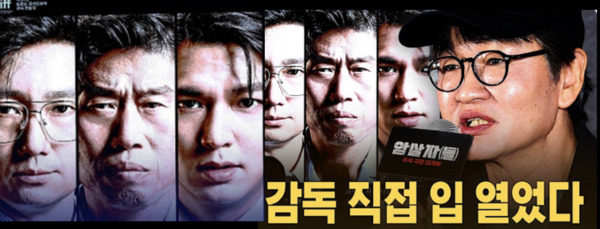
for what I see as serious historical distortion and even an affront to basic morality. But what angers me even more are the cowardly excuses offered by director Hur Jin-ho and the production team.
When controversy erupted over alleged historical distortion, Hur said the film was “a movie that continues to raise questions about unresolved aspects of events that actually occurred, rather than reaching any particular conclusion,” and asked audiences to “view the movie simply as a movie.”
He insisted that he was not convinced President Park Chung-hee was behind the shooting of First Lady Yuk Young-soo and argued that the phrase “the KCIA higher-ups” in the film did not refer to President Park. The production team likewise said, “This film was not made with any particular political purpose or intention, and we ask that it be viewed solely as a work of creative fiction.”
What cowardly and contemptible excuses.
Hur and the production team maintain that their purpose was “not to identify any particular mastermind,” that they were “not saying Park Chung-hee was behind it,” and that the movie “does not establish a conclusion but merely raises questions.”
Yet from the title itself to the dialogue throughout the film, it is already clear, in my view, that the director has predetermined the “conclusion” and is feeding audiences his answer to those questions.
Start with the title: The Assassin(s).
It is neither The Assassin nor The Assassins. The parenthetical “(s)” itself already suggests that there was someone else behind the assassin.
Audiences can infer the director’s intention from the title alone. The unusual form of the title allows viewers to anticipate the direction and conclusion of the film. They then watch the film through the lens suggested by that title and leave the theater having understood the director’s intention and received what the film presents as the answer to its questions.
Even if, for the sake of argument, we accept Hur’s claim that the film was not made with such a purpose or intention, the reactions of those who watched it show that his explanation amounts to little more than a flimsy excuse.
Just look at what actors and writers who attended the preview said:
Park Byung-eun — “It hurts, but the truth wins.”
Lim Soo-hyang — “Breathtaking moments in pursuit of the truth.”
Writer Kim Eun-hee — “‘Truth.’ I support The Assassin(s).”
Kim Byung-chul — “Truth, the present, and the future!”
Kim Yoo-mi — “Truth... Who is the assassin?”
Even if Hur’s explanation was sincere, he cannot deny that the result was precisely the opposite of what he now claims.
Hur says he wanted to portray the atmosphere of the period and how people viewed events at the time, reconstructing questions preserved in historical records into a cinematic narrative. But from the title onward, it appears that these were merely the process or means through which he sought to achieve what he actually wanted to show—or instill in—the audience.
Hur’s explanation of the phrase “KCIA higher-ups” is equally difficult to understand.
Hur said that the phrase did not mean President Park Chung-hee, but referred instead to a power struggle within the Korean Central Intelligence Agency at the time.
Does that make sense?
In that era, “above the KCIA” would naturally have been understood to mean the supreme authority—the president. What other institution could have been above it? The Presidential Security Service was not above the KCIA; it was a rival power organization. And if Hur meant a power struggle within the KCIA, that would mean a conflict involving the KCIA director and officials beneath him. How could that be described as “above the KCIA”?
Hur asks us to “view the movie simply as a movie,” but The Assassin(s) cannot be viewed simply as a movie.
Freedom of creation and freedom of expression must be protected. No particular historical event or individual should be exempt, and there should be no sacred territory beyond scrutiny.
But if directors and writers are to enjoy creative and expressive freedom, there are boundaries and rules they must observe.
A filmmaker may combine “established facts,” “disputed allegations and unresolved questions,” and “fiction created through the director’s or writer’s imagination.” There is nothing wrong with rigorously pursuing unresolved questions or using fiction and imagination to deepen a movie or increase audience immersion.
But established facts must not be distorted.
In particular, distorting an established fact that serves as the central motif of a film cannot simply be defended as creative freedom. A director cannot be free from responsibility for the consequences.
This film begins with the line:
“But chief, there were more gunshots after Moon Tae-gwang [Moon Se-gwang] had already been subdued.”
That line is the central mystery driving the movie from beginning to end. It would not be an exaggeration to say that The Assassin(s) is a film about solving the mystery raised by that line.
The line implies that First Lady Yuk Young-soo was struck by gunfire that occurred after Moon Se-gwang had already been subdued. In other words, it suggests that someone other than Moon—a third person, perhaps a KCIA agent—deliberately shot the First Lady.
The film makes the hypothesis that “there was separate gunfire after Moon had been subdued, and one of those bullets may have struck Yuk Young-soo” the central mystery of its narrative.
But what this line implies, I argue, is a clear distortion and falsehood.
The established account is that First Lady Yuk was fatally struck during Moon Se-gwang’s fourth shot. His first shot was an accidental discharge that struck his own thigh while he was drawing the gun. His second struck the podium where President Park was speaking. The third misfired. The fourth struck Yuk Young-soo in the head, and the fifth struck the Taegeukgi at the center of the venue.
The gunfire heard after Moon was subdued is believed to have come from presidential security officers. A female high school student participating in the choir was killed by gunfire attributed to a security officer.
The broadcast footage from the time, I argue, also shows the sequence. Before Moon was subdued, and before the security officers opened fire, Yuk Young-soo had already been struck and was collapsing sideways.
The film’s key line therefore assumes that Yuk had not yet been shot after Moon had been subdued—an account completely different from what I regard as the established sequence of events.
Turning such a distortion of an established fact into the central motif of a film is not creativity. It is, in my view, evidence that gives reason to suspect an ulterior intention and evidence that Hur’s explanation is false.
Of course, no director or writer can know every established fact. It may be understandable to misunderstand or distort a minor factual detail. But distorting an established fact that functions as the central mechanism of the entire film should not be tolerated.
Nor is it acceptable to say that the filmmakers failed to verify it or simply misunderstood it. Failing to verify—or misunderstanding—the central factual premise of a film cannot simply be dismissed as an innocent mistake or oversight by the director or writer. To me, it leaves the impression that the fact was deliberately left unchecked, or that the claim of misunderstanding is now being used as an excuse because the filmmakers had a predetermined purpose.
Some argue that six or seven gunshots were heard, that only four shell casings were recovered, and that one of the seven bullet marks was never identified. They cite these points as grounds for suspicion.
Others argue that because Moon was targeting President Park, it is strange that he hit First Lady Yuk, who was seated some distance away from the president.
But does whether six or seven gunshots were heard change the fact that Yuk Young-soo was struck during Moon’s attack?
Does the recovery of only four shell casings alter the conclusion that she died during the shooting initiated by Moon?
Does the failure to identify one bullet mark out of seven erase the established finding that Moon’s attack caused her death?
Those who cite shortcomings in the investigation as though they were evidence that Yuk was shot not by Moon but by a third person fail, in my view, to explain any meaningful connection between those unresolved questions and their conclusion.
After Moon’s first accidental discharge, people initially did not understand what was happening. When his second shot struck the podium where President Park was speaking, security officers rushed forward and people around Moon shouted and tried to restrain him. From the third shot onward, Moon could no longer aim properly, or his aim was disrupted by attempts to stop him. That is why bullets went elsewhere, striking Yuk Young-soo and the Taegeukgi rather than his intended target.
Yet some people treat this as evidence that a third person deliberately shot Yuk. I find that reasoning equally difficult to understand.
Hur appears cowardly to me particularly when his conduct is compared with that of actor Cha In-pyo.
Cha was once offered the role of a North Korean army colonel by a Hollywood production company. After reading the script, he reportedly concluded that the role demeaned North Korea and declined it. He gave up a substantial acting fee in order to stand by his convictions.
Hur, too, could simply state his purpose and intention openly and confront the controversy head-on. Or he could humbly accept criticism, acknowledge any errors and apologize.
Instead, through what I see as flimsy excuses, he has neither stood firmly by his convictions nor offered a courageous apology. He has reduced himself, in my view, to a commercial filmmaker concerned above all with selling a movie.
People who present themselves as intellectuals or progressives often invoke the phrase, “A nation that forgets its history has no future,” claiming that independence activist and historian Shin Chae-ho said it.
In fact, the phrase was neither coined by Shin Chae-ho nor by Winston Churchill, another figure to whom it is often attributed. Its exact origin is unclear, yet it is frequently quoted in Korea.
But when so many people watch a movie and then believe they know history, perhaps the phrase should be changed:
“A nation that learns its history from movies has no future.”In a country where a president once pushed a nuclear phase-out policy after watching the movie Pandora, how can Hur Jin-ho’s plea to “view the movie simply as a movie” sound anything but hollow?
#HurJinHo #TheAssassins #HistoricalControversy
* This article has been translated by ChatGPT.