
1,130 읽음
송도 의료 관광, 공항 인접성 앞세워 글로벌 허브 도약 중
 최보식의언론
 2
2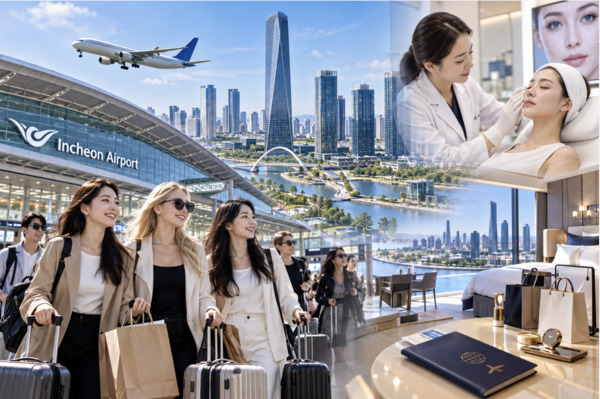
Behind this is Songdo’s unique geographical advantage: Incheon International Airport. Instead of getting off a plane and traveling all the way to Gangnam in Seoul, visitors can receive medical consultations and procedures in nearby Songdo, stay at a hotel, enjoy shopping and sightseeing, and then return to the airport. This gives Songdo considerable competitiveness as a medical tourism city.
The change is also evident in the statistics. In 2025, the number of foreign patients who visited dermatology clinics in Incheon increased by 169.5% from the previous year, while the number visiting plastic surgery clinics rose by 54.7%. By nationality, Japan, China, the United States, Kazakhstan, Mongolia, and Vietnam are among the major markets.
It would therefore be inaccurate to characterize this phenomenon as medical tourism by Chinese visitors alone, although China is certainly one of the important customer markets. The increase in foreign patients coming to Incheon has continued into 2026.
The economic impact cannot be ignored either. Foreign patients do not spend money only at hospitals. They stay at hotels, eat at restaurants, take taxis, and go shopping. According to Incheon’s figures citing data from the Korea Health Industry Development Institute, foreign patients in Incheon spent 112 billion won by credit card in 2024. Attracting a single patient therefore generates activity across medical care, accommodation, food, transportation, and shopping.
Songdo has favorable conditions for expanding this business. It has Incheon International Airport as an international gateway, while hotels, shopping facilities, and an international business district are concentrated in one area. Its image as a modern new city located not far from the airport is itself an attraction for overseas medical tourists. Airport accessibility is an especially significant competitive advantage for medical services involving relatively short stays, such as cosmetic surgery and dermatological procedures.
That does not mean everything should be viewed through rose-colored glasses. As medical tourism grows rapidly, several potential side effects are also likely to increase.
The first issue to consider is the excessive commercialization of medical care. Much of the foreign-patient market for plastic surgery and dermatology consists of services not covered by national health insurance. When high profits are expected, medical capital and personnel naturally move toward those fields. In a market economy, this is a natural phenomenon. The problem arises when the entire regional medical system becomes excessively concentrated in those areas. If hospitals providing cosmetic procedures to foreign patients make far more money than pediatrics, emergency care, or internal medicine services needed by local residents, an imbalance in the supply of medical care could emerge.
The second issue is the risk of dependence on a particular country. The Chinese market is large. But precisely because it is large, it also carries risks. If Korea-China relations deteriorate, the Chinese government changes its policies concerning overseas travel or medical treatment, China’s economy slows, or exchange rates fluctuate, demand for medical tourism could also be affected. Korea’s tourism industry has already experienced the risks of excessive dependence on Chinese group tourists in the past. For Songdo’s medical tourism industry to grow, it should actively utilize the Chinese market while diversifying its customer base across Japan, the United States, Southeast Asia, Central Asia, and other regions. In fact, foreign patients coming to Incheon already come from a variety of countries.
The third issue is brokers. Foreign patients find it difficult to directly compare the quality and prices of Korean hospitals. They speak different languages and are unfamiliar with Korea’s medical system. This creates a role for patient-attraction agencies that refer patients to hospitals in exchange for commissions. Legitimate patient-attraction businesses are a necessary part of the industry. The problem arises when excessive referral fees and opaque contracts become involved. As competition to attract patients intensifies, the ability to bring in more patients could become more important than the quality of medical care itself.
That is why existing law does not simply allow anyone to attract foreign patients. Medical institutions seeking to attract foreign patients must satisfy certain registration requirements and must also carry medical malpractice liability insurance or participate in a medical indemnity mutual-aid association. Businesses that attract foreign patients are likewise required to meet requirements involving guarantee insurance, capital, and other conditions.
The fourth issue is how medical accidents are handled afterward. This is an important distinction between ordinary tourism and medical tourism. A problem with an item purchased by a tourist is entirely different from a problem with the body of someone who has undergone surgery. What happens if a Chinese patient who underwent plastic surgery develops complications such as infection, bleeding, or nerve damage after returning home? The patient may have to return to Korea and could become involved in a dispute with the hospital over responsibility.
This is also why the law provides for liability insurance. Clinics and hospitals that attract foreign patients are currently required to maintain medical malpractice liability insurance or equivalent coverage meeting certain requirements. But the existence of insurance does not eliminate the difficulties involved in resolving cross-border medical disputes.
Songdo’s medical tourism strategy therefore should not stop at attracting a few more plastic surgery clinics and bringing in large numbers of foreign patients. Price disclosure, interpretation services, accreditation of medical institutions, supervision of patient-attraction agencies, responses to medical accidents, and follow-up care after patients return home should all be developed as parts of a single industry. Only then can Songdo become an international medical city where people can receive treatment with confidence, rather than merely a city they briefly visit in search of inexpensive procedures.
Above all, Songdo does not need to simply replicate Gangnam. If Gangnam is a massive cluster for plastic surgery and dermatological beauty treatments, Songdo possesses an asset that Gangnam can never have: Incheon International Airport. By combining advanced treatment at general hospitals, health screenings, dermatology and plastic surgery, accommodation, and tourism, Songdo could create an entirely different model of medical tourism. Incheon is likewise pursuing a strategy of developing both advanced treatment and less severe or cosmetic medical services.
Foreigners coming to Korea and purchasing medical services with their own money while spending at hotels, restaurants, and shops is fundamentally something to welcome. It is little different from exporting high-quality medical services. There is no reason to be wary simply because the patients are Chinese, nor is there any need to start worrying merely because the number of foreign patients is increasing. What must be distinguished, however, is successful medical tourism from a disorderly proliferation of medical businesses.
A valuable opportunity lies before Songdo because it sits right next to Incheon International Airport, South Korea’s largest international gateway. Songdo should use this geographical advantage to attract foreign patients while raising the quality of medical care, price transparency, patient safety, and follow-up services to international standards. The mere fact that large numbers of Chinese patients visit Songdo does not in itself mean that Songdo’s medical tourism industry is a success.
More important than how many patients are brought in is what kind of treatment they receive and what impression they take home with them. If Songdo can achieve that, Incheon International Airport can become more than a gateway through which foreigners enter and leave Korea. It can become a gateway through which Korean medical services reach the global market.
#Songdo #MedicalTourism #KoreanHealthcare
* This article has been translated by ChatGPT.