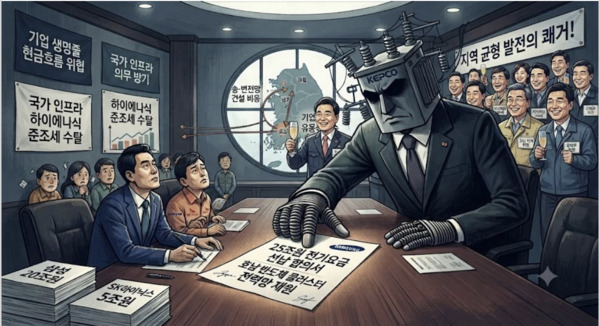
[Choice Times=Jin-an Kim, Former Head of Samsung Electronics Central Europe Region]Korea Electric Power Corporation (KEPCO) has asked Samsung Electronics and SK hynix to prepay 25 trillion won in electricity bills for the next five years. The idea is to tap the semiconductor giants’ cash reserves and use the money to finance power-grid investment for the Honam semiconductor cluster, in an attempt to cope with more than 210 trillion won in debt and the approaching ceiling on KEPCO bond issuance. On the surface, it is being packaged as a win-win arrangement in which the interests of major corporations seeking to secure electricity supplies early and KEPCO seeking financing coincide. But it contains a fatal contradiction: it shifts the responsibility for providing national infrastructure onto the private sector and sets an extremely dangerous precedent. The total amount KEPCO has requested from the two companies in advance is 25 trillion won—20 trillion won from Samsung Electronics and 5 trillion won from SK hynix. The figure represents five years of electricity bills from 2027 through 2031, calculated on the basis of what the companies paid last year—4.1 trillion won for Samsung Electronics and 900 billion won for SK hynix. Under the proposed terms, the two companies would pay roughly 2 trillion won per month over about 12 months. KEPCO would deduct their actual monthly electricity charges from the prepaid amounts and, every six months, pay interest on the remaining balance at a rate 0.15 percentage points higher than the yield on two-year government bonds—not in cash, but by deducting the interest from future electricity bills. Electricity, water and roads are fundamental public infrastructure that the state and public corporations are naturally responsible for building and supplying. Companies have already borne their fair share of the social cost of building national infrastructure by paying enormous amounts in taxes. The idea that the government and a public corporation would extract cash from private companies to finance transmission and substation networks that they themselves are responsible for building, under the pretext of investing in a large-scale semiconductor cluster, is tantamount to abandoning the state’s basic responsibility to provide infrastructure. If this logic is accepted, the Korea Expressway Corporation could demand advance payments for road-network construction and highway use. Later, the railway operator might extend its hand and demand advance payment for KTX use. Going even further, authorities could argue that Gwangju needs a general hospital, educational facilities, shopping malls and even apartments to improve local living conditions, demand that semiconductor companies pay the construction costs upfront, and then have Gwangju City and LH repay the money later with interest. Such absurd logic could easily follow. For public institutions to imitate infrastructure-bond financing by turning to private corporations simply to avoid strains in the bond market is administrative expediency that forgets their fundamental role. In corporate management, cash is nothing less than a lifeline. In the highly uncertain global semiconductor battlefield, it is nearly impossible to predict market conditions even one or two years ahead. Forcing companies to lock up tens of trillions of won in cash immediately under the name of future electricity bills amounts to draining away the very liquidity they must defend at all costs—not only to develop cutting-edge technologies and make massive capital investments, but also to survive the next global economic crisis. Governments in competing countries such as the United States, Taiwan and Japan are desperate to attract companies by offering tax credits and subsidies and providing infrastructure virtually free of charge. Yet our government and public corporations are busy squeezing successful companies and eating away at their liquidity. After tying companies down with the rigidity of the 52-hour workweek, pressuring them over various labor-union issues and even having the labor minister intervene repeatedly over performance bonuses, are they now going to raid private pockets to finance power-grid investment as well? This goes beyond brutally trampling on companies’ autonomy in managing their funds. It is a fatal act of self-harm that undermines the country’s future industrial competitiveness with its own hands. In particular, demanding that Samsung Electronics alone prepay a staggering 20 trillion won in future electricity bills is, from the standpoint of corporate financial management, an utterly unacceptable and foolish act. For a company, tens of trillions of won are its most precious ammunition, to be invested with everything at stake in research and development (R&D) and factory construction. KEPCO is dangling the meager incentive of an interest rate barely above government-bond yields. But in the midst of fierce global competition, can the value of urgently needed corporate liquidity possibly be compared with such a small amount of interest? If 20 trillion won is tied up in prepaid electricity bills and market conditions suddenly change or an emergency arises in which liquidity becomes desperately needed, there is little chance KEPCO would simply return the money. The company could end up in the absurd position of being unable to use its own money while having to borrow from the market at higher interest rates. When global investors assess the Korean market, among the indicators they scrutinize most closely—alongside fundamentals and technological competitiveness—are the predictability of the business environment, the rule of law and protection of private property rights. In a normal country, the government and public institutions should take responsibility for infrastructure construction under long-term plans. But if the government tolerates or turns a blind eye to the unconventional practice of collecting several years’ worth of electricity bills from private companies in advance, overseas investors will come to see Korea as a market governed not by law and principle but by political logic and administrative convenience. A structure in which tens of trillions of won in liquidity is tied up in the wrong place—not because of autonomous decisions by corporate management but to fill the government’s financial gaps—is a clear destruction of shareholder value and runs counter to global standards. It can only deepen the Korea discount and become a major cause of foreign capital flight. When a public corporation mobilizes private corporate funds to meet the government’s policy needs, it is effectively no different from a quasi-tax. Now that the two companies are generating astronomical operating profits, all sorts of actors appear to be rushing in like hyenas to tear off a piece. One cannot help but ask whether this is the true face of the current government’s idea of “profit sharing.” The government’s duty should be to support successful companies so they can become even more competitive on the global stage. Instead, it seems obsessed with extracting their money. This behavior itself is a genuine national risk. When KEPCO came forward with such an outrageous proposal, the government should immediately have reprimanded it and ordered it to abandon the idea. But with KEPCO applying what amounts to pressure while relying on the enormous backing of the government, companies are trapped in a dilemma in which even openly refusing the proposal becomes difficult. Going a step further, KEPCO now appears intent on transforming its existing advance-payment system, originally designed for the convenience of customers, into a large-scale financing tool by institutionalizing a separate “special system for large-scale advance payment of electricity bills.” It must be made absolutely clear whether this meticulously designed and ruthless scheme originated within KEPCO itself or was jointly devised by left-wing forces within the government. When the administration changes and time passes, all these excessive measures will eventually be recorded as yet another enormous “deep-rooted evil.” It is difficult to understand how those responsible intend to bear the political and legal consequences when that time comes. It is astonishing that KEPCO is offering a paltry interest rate comparable to a bank time deposit while acting as though it were granting some extraordinary benefit. If KEPCO’s business conditions have deteriorated and it is struggling to raise funds, the proper course is to issue bonds, pay the higher interest required and raise the money in the market. It must immediately stop this shameless attempt to twist companies’ arms and shift its own financial burden onto them. It is hard to believe such an absurd and outrageous situation could occur. KEPCO’s debt crisis is a structural problem caused by the accumulated effects of lax management, an unrealistic electricity-pricing system and avoidance of restructuring. The very idea of securing cash it does not currently possess by pulling forward several years of future revenue falls far outside the bounds of normal corporate management. Using future sales that have not even materialized as collateral to raise enormous amounts of cash is nothing more than accounting sleight of hand designed to conceal massive debt and keep rolling it over. KEPCO may try to use the 25 trillion won in advance payments to get past the immediate crisis surrounding its bond-issuance ceiling. But without fundamental efforts to restore financial soundness and reform itself, if it merely raids private pockets as a temporary expedient and fails even to understand the volatility of the global economy, genuine structural reform will remain impossible forever. If the semiconductor market plunges sharply as early as next year, or if Samsung Electronics and SK hynix are pushed by intense U.S. investment pressure into relocating large-scale production facilities to the United States, this enormous 25 trillion won advance-payment structure could turn into an unmanageable time bomb. In an emergency in which earnings collapse because of deteriorating market conditions and the companies must pour liquidity into overseas investment, the trillions of won already tied up with KEPCO would become a shackle around their necks. The state and a public corporation would be raiding private pockets to put out an immediate fire, only to march together toward disaster when the real risks—global market volatility and overseas relocation—materialize. Ultimately, the idea of forcibly drawing companies into the Honam semiconductor cluster to produce a policy achievement and then making those same companies pay for the infrastructure out of their own pockets amounts to excessive pressure far beyond the bounds of administrative common sense. Is this supposed to be the first gift from the Honam region? It is simply astonishing. If the government lacks the financial capacity to build the necessary infrastructure itself, it should reconsider from the ground up whether it is qualified to pursue the policy at all. This coercive method of financing, which holds corporate liquidity hostage to patch fiscal holes, will merely establish a damaging precedent that ultimately places a heavy burden on the entire South Korean economy. This is also evidence that the government rushed ahead with the Honam semiconductor industrial complex without even examining the investment capacity of public corporations such as KEPCO and the Korea Water Resources Corporation when drawing up the project. If KEPCO’s plan fails to materialize, will the government then delay or abandon transmission infrastructure for the Yongin semiconductor cluster in order to prioritize the Honam semiconductor complex?
 최보식의언론
 1
1