
323 읽음
Why Did President Lee Insist on Meeting Brazil's Lula Despite Rising Tensions with the United States?
 최보식의언론
 0
0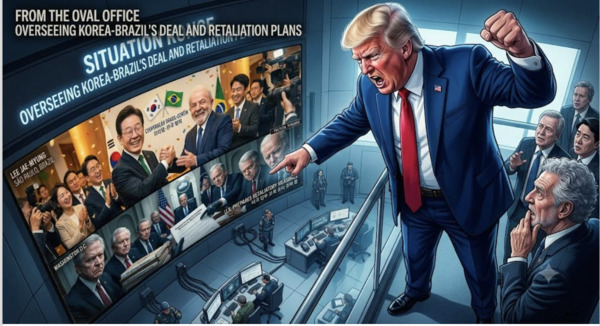
and
to project a diplomatic message can fundamentally alter the balance sheet of national interests.
Few would dispute the value of strengthening ties with Brazil—the largest economy in South America and a key supplier of critical minerals—or advancing a Korea–Mercosur free trade agreement. The real question, however, is: Why now, and why at a metalworkers' union office?
Washington's Growing "Anti-U.S. Economic Discrimination" Narrative
The global trade environment is becoming increasingly sensitive.
Recently, members of the U.S. House of Representatives introduced the No Racketeers on Our Shores Act, legislation that would deny entry to—or even deport—foreign government officials accused of discriminating against or excessively regulating American companies. Whether the bill ultimately becomes law remains uncertain.
What matters more is that concerns over foreign regulatory practices are no longer confined to a handful of lawmakers. Similar thinking has rapidly gained traction across Capitol Hill, the House Judiciary Committee, the State Department, and the White House.
The bill's accompanying fact sheet specifically groups South Korea's regulatory actions toward Coupang together with the European Union's regulation of Google and Brazil's policies toward Big Tech as representative examples of what it characterizes as a global trend of discrimination against American businesses.
Washington's skepticism toward South Korea's market regulation has reached a level where discussion extends beyond traditional trade retaliation by the U.S. Trade Representative (USTR) to the possibility of targeted sanctions against individual foreign policymakers, including restrictions on entry into the United States.
Brazil Has Become One of Washington's Most Sensitive Trade Flashpoints
Brazil has emerged as one of the most sensitive fault lines in today's U.S. trade environment.
President Luiz Inácio Lula da Silva's left-wing administration has pursued aggressive regulation of American technology companies while clashing repeatedly with the Trump administration and many policymakers in Washington over judicial, trade, and economic issues. The disputes have escalated into reciprocal tariff threats and broader political confrontation.
Within much of Washington, Brazil is increasingly viewed as a country whose state-led regulation and labor-oriented policies undermine the interests of American businesses.
Under these circumstances, South Korea's highest diplomatic priority should arguably have been ensuring that it was not perceived as aligning itself with Brazil's anti-American regulatory framework, while proactively reducing potential misunderstandings in Washington.
The Symbolism Raised Difficult Questions
Against that backdrop, the imagery surrounding President Lee's visit has generated concern.
During the summit, considerable emphasis was placed on the personal narratives of both leaders as former factory workers, while a visit to a prominent metalworkers' union office in São Paulo became one of the signature events of the trip.
At a time when Washington is already closely examining South Korea's regulatory policies alongside Brazil's, such symbolism may be interpreted as suggesting political or ideological solidarity between the two countries on trade and regulatory matters.
To observers in Congress or the executive branch, the visit could reinforce the perception that South Korea is moving closer to Brazil's regulatory philosophy.
Diplomacy Must Not Be Driven by Symbolism Alone
Diplomacy should never become captive to symbolism.
Even if securing critical mineral supply chains serves South Korea's national interests, summit diplomacy that fails to account for the broader geopolitical implications of its messaging risks becoming a boomerang—particularly when the United States remains South Korea's most important export market.
Resource and supply-chain cooperation with Brazil could have been pursued quietly through regular working-level diplomatic and trade channels.
Symbolic summit diplomacy, by contrast, requires much greater caution and calibration, particularly when Washington's scrutiny of South Korea's trade and regulatory policies is intensifying.
South Korea should avoid repeating diplomatic timing mistakes that unintentionally heighten concern in Congress and the White House while increasing unnecessary trade risks.
At a time of mounting pressure in U.S.–Korea trade relations, what South Korea needs is not symbolic diplomacy emphasizing ideological affinity, but pragmatic diplomacy grounded in a careful calculation of national interests.
jinannkim@gmail.com
#SouthKoreaDiplomacy #USKoreaRelations #Geopolitics
* This article has been translated by ChatGPT.