
1,623 읽음
Did JTBC Commit Fraud? A Mirror Image of the Homeplus Scandal
 최보식의언론
 0
0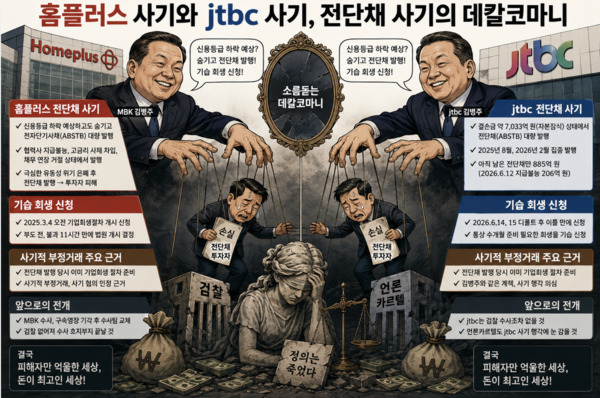
The alleged commercial paper fraud involving Homeplus and the recent JTBC case look almost like mirror images of one another.
The allegations against Homeplus management and its largest shareholder, MBK Partners, are straightforward.
According to prosecutors, Homeplus issued Asset-Backed Short-Term Bonds (ABSTBs) while allegedly concealing an expected downgrade in its credit rating and then abruptly filed for corporate rehabilitation, causing losses to bond investors.
In reality, Homeplus had already been suffering from a severe liquidity crisis before issuing the short-term bonds. It reportedly faced supplier payment failures, relied on high-interest borrowing, and had even been denied extensions on existing debt obligations.
Despite this situation, the company allegedly continued issuing large amounts of ABSTBs, exposing bondholders and brokerage firms to significant losses.
JTBC appears strikingly similar.
On June 12, 2026, Mirae J2 and Jeil TBC J2 defaulted on obligations totaling KRW 5.6 billion and KRW 15 billion respectively. Both were ABSTBs. Yet approximately KRW 88.5 billion worth of such securities remain outstanding.
Most of these instruments were issued during concentrated periods in August 2025 and February 2026.
Like Homeplus, JTBC reportedly issued these securities while operating under severe capital impairment, with accumulated losses approaching KRW 703.3 billion.
Homeplus filed for corporate rehabilitation even before a formal default occurred.
On the morning of March 4, 2025, Homeplus unexpectedly submitted an application for court-supervised rehabilitation proceedings.
Even more remarkable was the court's response.
Although the company had not formally entered bankruptcy, the court approved rehabilitation proceedings within just 11 hours.
JTBC followed a similar path.
Only two days after defaulting, it filed for rehabilitation proceedings on June 14 and 15.
Ordinarily, preparing a corporate rehabilitation filing requires months of planning and documentation.
When prosecutors sought arrest warrants against MBK Chairman Kim Byung-joo and others in the Homeplus case, one of the key factors supporting allegations of fraudulent transactions was the claim that rehabilitation preparations had already been underway while the short-term bonds were still being sold.
JTBC, according to this argument, employed a similar strategy.
JTBC may attempt to justify its financial distress by pointing to losses related to World Cup broadcasting rights investments. However, that explanation is difficult to accept.
The company acquired World Cup and Olympic broadcasting rights back in 2019.
Critics argue that issuing large volumes of short-term debt while burdened by roughly KRW 700 billion in speculative broadcasting-rights investments and facing severe liquidity stress raises serious questions about the company's conduct.
The future trajectory of the case may also resemble the Homeplus affair.
The MBK investigation lost momentum after arrest warrants were denied and investigative teams were reshuffled.
Since then, progress has remained largely opaque.
Some critics believe the case will ultimately fade away without meaningful consequences.
They predict that JTBC may not even face a comparable prosecutorial investigation.
In their view, political and media interests will ensure that scrutiny remains limited.
As a result, they argue, the ultimate victims will once again be ordinary investors.
In the end, it becomes a world where victims are left with grievances while money remains the supreme value.
#ABSTB #InvestorProtection #FinancialScandal
#SouthKorea #MediaIndustry #CorporateGovernance
* This article has been translated by ChatGPT.