
1,336 읽음
An Era When Big Portals Judge the 'Truth'? The 21st-Century Outsourcing of Censorship
 최보식의언론
 0
0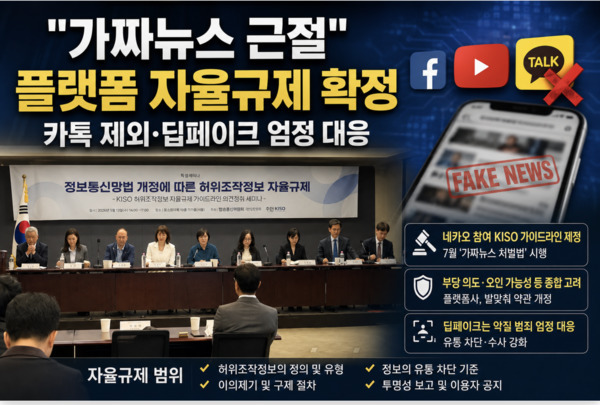
In July, South Korea's so-called "Fake News Punishment Act" (an amendment to the Information and Communications Network Act) is set to take effect.
In parallel, the Korea Internet Self-Governance Organization (KISO), which includes Naver and Kakao among its members, has unveiled self-regulatory guidelines aimed at blocking what it defines as false and manipulated information.
The stated purpose sounds polished enough: stop AI-generated deepfakes and eliminate malicious misinformation. The decision to exclude private messaging services such as KakaoTalk and email from the regulatory framework is equally clever, allowing supporters to sidestep accusations of direct private censorship.
Yet once the packaging is removed and the underlying mechanism is examined, a far more unsettling blueprint emerges—one that resembles a managed and controlled society. We must look beyond the word "self-regulation" and recognize the enormous concentration of power concealed behind it.
Consider first the logic behind the newly introduced image-monitoring provisions targeting large online communities.
The rationale sounds reasonable at first glance. But anyone applying basic common sense may find it difficult not to laugh.
Would actual criminals really upload illegal manipulated content or deepfakes onto massive public forums visited by millions of users?
Serious offenders have long since migrated to encrypted foreign platforms such as Telegram or hidden, invitation-only networks specifically designed to evade surveillance.
If authorities cannot effectively reach the real criminals who actively avoid law enforcement, why focus so intensely on public discussion boards?
The answer, critics argue, is obvious.
Crime prevention serves as the public justification, but the practical effect may be the monitoring and control of political memes, satire, and spontaneous public opinion generated by ordinary citizens in digital public squares.
It is less about catching criminals and more about placing surveillance cameras in the middle of the town square.
The proposed standards for identifying false or manipulated information raise even deeper concerns.
The guidelines refer to content created for "unfair gain," material that infringes upon "personal rights," or information that harms "the public interest."
But who determines where truth ends and falsehood begins within such broad and subjective language?
Not courts.
Not prosecutors.
Not independent judges.
Instead, that authority is effectively delegated to private portal platforms whose primary purpose remains commercial profit.
Direct state censorship would inevitably trigger accusations of authoritarianism. Therefore, critics argue, the power to censor is instead transferred through private terms-of-service agreements controlled by dominant technology platforms.
This, they contend, represents the most sophisticated form of twenty-first-century censorship: censorship outsourced to private corporations.
The way such a system may operate in practice is not difficult to imagine.
Few platforms would willingly risk conflict with a governing party that commands a parliamentary majority and possesses the power to summon corporate executives before public hearings.
If a conservative YouTuber or citizen raises allegations of corruption against President Lee Jae-myung, critics fear such content could quickly be classified as misinformation or an infringement of personal rights and be removed or suppressed.
At the same time, they argue, politically aligned commentary targeting conservatives may continue to enjoy broad protection under the banners of free expression or satire.
Government officials could then distance themselves from responsibility, insisting that no state censorship occurred and that any content removal resulted solely from private corporate decisions.
The more ambiguous the standards become, the more likely it is that corporations holding enforcement power will lean toward political authority.
Historical context makes the situation appear even more ironic to critics.
Who, they ask, are the loudest advocates today for aggressive crackdowns on so-called fake news?
They point to figures who previously promoted controversial narratives ranging from mad cow disease fears to conspiracy theories surrounding the Sewol ferry disaster, as well as numerous other disputed claims that circulated widely in South Korean politics.
In this view, those who once benefited politically from misinformation are now seeking mechanisms to regulate and control independent media voices that challenge their authority.
History offers a recurring lesson: those who gain power through revolutionary rhetoric often become the first to establish checkpoints restricting speech once power is secured.
Wrapped in the language of crime prevention and misinformation control, critics argue that the emerging system bears a striking resemblance to the "Ministry of Truth" described in George Orwell's1984.
Once private platforms are empowered to define acceptable truth through contractual rules and content moderation policies, they warn, South Korea's online public sphere could gradually transform into a sterile environment where only officially tolerated narratives remain visible.
The sharpest weapon against freedom has rarely arrived openly.
More often, it comes wrapped in a gentle promise:
"We are only doing this to protect you from danger.“
#FreedomOfSpeech #DigitalCensorship #FakeNewsLaw
#SouthKorea #InternetRegulation #PlatformGovernance
#KISO #FreeExpression #DigitalRights
* This article has been translated by ChatGPT.