
142 읽음
오세훈 서울시장 당선, 출구조사 결과 뒤집고 승리
 최보식의언론
 0
0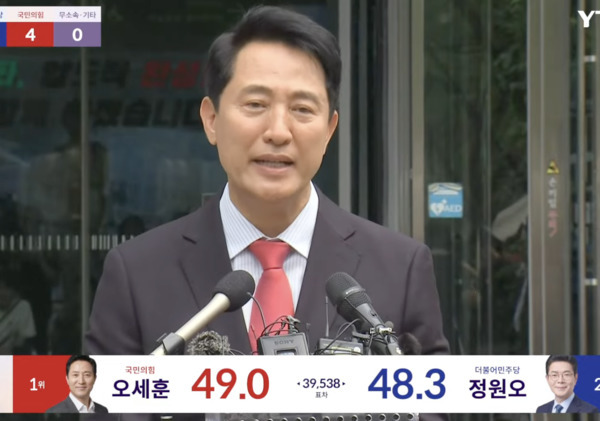
Yet I found it difficult to accept that conclusion. Throughout the campaign, I had closely followed Seoul’s political landscape and public sentiment. My assessment was that this election would ultimately become an extremely close contest. Seoul mayoral elections possess unique characteristics that cannot be explained solely by party affiliation or ideological alignment. Therefore, I believed it was necessary to wait until the very end before concluding that a five-point exit-poll gap would translate into the final result.
So I refused to give up hope. As vote counting began, Seoul entered a long and sleepless night. Countless citizens remained glued to television screens and mobile phones, anxiously watching every update. I was no exception. Midnight passed. Then came 2 a.m., and later 4 a.m. Yet the miracle had not appeared. Mayor Oh continued to narrow the gap, but not enough to inspire confidence in an eventual victory. The prolonged counting process only heightened the tension and uncertainty.
As dawn approached, the election evolved into more than a simple vote count. It became a political drama. Broadcasters struggled to explain the growing discrepancy between the shocking exit poll and the actual counting results. Social media buzzed with debate throughout the night. Some believed the race was already over, while others continued to cling to hope. Both groups spent the same sleepless night, driven by different expectations and anxieties.
Seoul did not sleep. Nor did democracy. Even as daylight emerged over the city, the winner had yet to be determined. Many people had grown exhausted. Some had begun accepting what they believed would be the inevitable result. Yet the election was still not over.
Then, at approximately 9:00 a.m. on June 4, Seoul produced a miracle. After nearly fifteen hours of vote counting, Mayor Oh Se-hoon completed a dramatic comeback and secured victory. What had seemed impossible became reality. Exit polls and countless predictions ultimately yielded to the actual choices made by voters.
At that moment, I was reminded once again of the true essence of democracy. Neither pollsters, television networks, nor political commentators determine the winner of an election. Only the people do.
And the citizens of Seoul demonstrated that truth in the most dramatic way possible. In fact, the outcome confirmed a conclusion I had consistently argued throughout the campaign. In multiple columns, I predicted that the election would ultimately be decided by a margin of roughly one percentage point or less. While many polls suggested a significant disadvantage for Mayor Oh—and while the exit poll effectively declared his defeat—I never fully accepted that narrative.
The reason was simple. Elections are not determined by polling numbers. They are determined by voters who actually show up at the ballot box. Moreover, unlike presidential or parliamentary elections, a mayoral election places significant emphasis on a candidate’s administrative experience, governing competence, and vision for the city.
Throughout the campaign, I paid close attention to the atmosphere across Seoul. Seoul citizens do not vote solely along party lines. They evaluate actual achievements, urban transformation, and future plans. Consequently, there were clear limits to interpreting the race exclusively through national political trends. .It was precisely in that space that I saw the possibility of a late shift in momentum. Hidden votes and last-minute voter consolidation are factors that polls often fail to capture.
Many observers have compared this election to the 2010 Seoul mayoral race between Oh Se-hoon and Han Myeong-sook. In that election, Oh won by only 0.6 percentage points, approximately 26,000 votes. Yet this election was arguably even more difficult to predict. Whereas the 2010 race was largely driven by a referendum on the national government, the 2026 election was shaped by a complex combination of political polarization, the momentum of a newly elected administration, and the personal competitiveness of the mayoral candidates themselves. No outcome could be taken for granted.
This election carried significance far beyond a local contest. It was a referendum on Seoul’s future and an important indicator of the direction of South Korean politics.
Seoul is not merely the nation’s capital. It is the political, economic, cultural, and international center of the Republic of Korea. Its budget surpasses that of many provincial governments, and its global influence is often comparable to that of a national government. This is why international leaders frequently treat the Mayor of Seoul as a figure of national stature.
As Secretary-General of the World Smart Sustainable Cities Organization (WeGO), I have witnessed this reality firsthand while working with cities around the world. Just as the futures of London, Paris, New York, and Tokyo carry national implications, the future of Seoul is inseparable from the future of Korea.
For conservatives, the significance of this election was even greater. Following two presidential impeachments in 2017 and 2025, the conservative movement entered a period of profound uncertainty. Organizational structures weakened, leadership networks fractured, and many questioned whether a meaningful political recovery remained possible.
Under such circumstances, retaining Seoul represented far more than a local electoral victory. It secured a critical foundation for political renewal. If conservatives had lost Seoul, rebuilding momentum for the future would have become significantly more difficult. By preserving Seoul, they maintained a platform from which to develop policies, cultivate future leaders, and prepare for the 2030 presidential election.
Yet the significance of this victory should not be confined to the interests of any single political party. Democracy does not exist to guarantee permanent rule by any one faction. Healthy democracy requires healthy competition. A governing party is necessary, but so too is a credible opposition capable of monitoring and challenging those in power. That is a fundamental principle of liberal democracy. When excessive power becomes concentrated in any one institution—whether the executive branch, legislature, judiciary, media, or local government—the health of democracy can suffer. Checks and balances are essential safeguards of freedom and political choice.
History repeatedly demonstrates that democratic decline often begins when power becomes overly concentrated. The strength of democracy lies not in monopoly, but in competition and balance. In that sense, this election was never merely about choosing a mayor. It was a demonstration that South Korea’s democracy continues to function through competition, accountability, and the choices of its citizens.
During his tenure, Mayor Oh pursued a broad range of initiatives, including redevelopment and reconstruction reforms, the Seoul Learn program, support for vulnerable populations, the Han River development projects, the Yongsan International Business District, and investments in advanced industries. Reasonable people may disagree about individual policies. Debate and criticism are natural components of democratic governance. Nevertheless, it is difficult to dismiss his administrative experience, governing capacity, and long-term vision for the city. Ultimately, voters chose performance over slogans and leadership over political branding. That choice shaped the outcome of this election.
Watching this election unfold strengthened my faith in the wisdom of citizens. I trust the judgment of voters more than opinion polls, common sense more than political engineering, and Seoul’s future more than ideological division. And above all, I continue to believe in the resilience and determination of Mayor Oh Se-hoon.
The campaign was anything but easy. He faced the momentum of a newly inaugurated president, strong support from the governing camp, unfavorable forecasts, and relentless political attacks.
Yet he endured. And in the end, the people rewarded that perseverance.
For that reason, I would like to express my sincere gratitude to Mayor Oh. Thank you for surviving for Seoul. Thank you for surviving for the conservative movement. And most importantly, thank you for surviving for the balance and liberal democratic values of the Republic of Korea.
Yet this election leaves us with another important challenge. The challenge is public trust in the administration of elections. In a democracy, elections are sacred. But the institutions that manage elections must never become untouchable.
In recent years, controversies involving hiring irregularities, accountability failures, and management deficiencies within the National Election Commission have raised legitimate public concerns. Moreover, during this election, questions emerged regarding ballot shortages, lengthy waiting times, and operational confusion in certain districts. In areas such as Songpa, Gangnam, and Dongjak, some citizens questioned whether election preparations adequately reflected anticipated voter turnout. All such concerns must be examined objectively and thoroughly. At the same time, dismissing every question as a conspiracy theory is neither constructive nor democratic. Democracy is not a system that suppresses questions. It is a system that seeks facts.
Citizens are prepared to accept election outcomes. But acceptance depends on trust. If public confidence in election administration erodes, the foundations of democracy itself may weaken.
At this stage, no allegations should be accepted without evidence. Precisely for that reason, transparent investigation and verification are essential. If deficiencies are ultimately found—whether in planning, administration, or execution—they should be addressed openly and responsibly.
South Korea’s National Election Commission enjoys a level of institutional independence and authority rarely seen elsewhere in the world. Such independence, however, must be accompanied by accountability and transparency. Independence gains legitimacy only when matched by responsibility.
Electoral reform should not be viewed as a partisan demand. It is a democratic necessity. The ultimate goal is simple: to create an election administration system trusted by all citizens.
The most important lesson from this election is clear. The future of Seoul belongs to its citizens. The future of democracy likewise depends upon informed and engaged citizens.
During fifteen extraordinary hours, Seoul once again wrote history. Against predictions, assumptions, and expectations, citizens demonstrated who the true owners of democracy really are.
In the end, the citizens won. In the end, Seoul won. And once again, we were reminded that the true victor in any democracy is neither the pollster, nor the political establishment, nor the media. It is the citizen. Because until the very end, it is never truly over. History has always been written by citizens who refuse to surrender hope until the final moment.
jeongkeekim@naver.com
#SeoulMayoralElection
#OhSeHoonVictory
#ElectionReform