
802 읽음
Iran: “We Attacked HMM”... And Then Came the Blue House’s Suspicious Response?
 최보식의언론
 0
0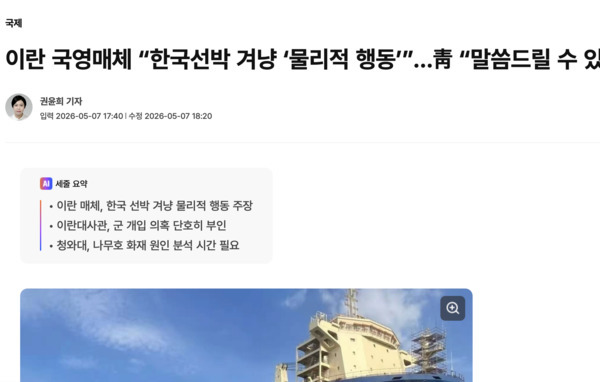
In response, the Blue House appeared eager to avoid acknowledging the possibility of an attack, saying that “it will take time to analyze the cause,” while National Security Adviser Wi Sung-lac maintained that “it is not certain the vessel was attacked,” further fueling controversy.
From the very heart of South Korea’s foreign and security establishment, the Blue House, all that emerges is the powerless statement: “There is nothing we can say at this time.” Meanwhile, Iran — the alleged perpetrator — is proudly sounding a victory trumpet through its state media, openly declaring that it carried out “a physical action targeting a Korean vessel that violated the new rules we established.” Yet the victim, South Korea, seems desperate to dismiss the confession itself as misinformation. This is not merely a delay in intelligence assessment. It is a classic case of “cognitive avoidance” by those who lack the courage to confront an uncomfortable truth.
History shows that nations which deny even the aggressor’s own confession inevitably become the next targets of invasion. In the late 19th century, the powerless Korean court of the Joseon Dynasty disguised the encroachments of foreign powers as “benevolent exchanges,” denying reality even as the nation was collapsing from within. The silence now displayed by the Lee Jae-myung administration is little different from a de facto declaration of surrender to Iran’s “strategic redefinition” — its unilateral expansion of Hormuz jurisdiction into UAE territorial waters while making Korean ships an example.
Even more pitiful is the national security adviser’s insistence that “it is not certain the vessel was attacked,” while attempting to steer the cause of the fire toward technical malfunction. Iran has already boasted that it shocked the United States and its allies by extending its operational boundary all the way to the port of Fujairah. The criminal is openly bragging, “I fired the shot, and it was a masterstroke,” while the detective responds, “We heard gunfire, but it might have been fireworks,” effectively refusing to investigate at all. Security conducted in this manner is not a shield protecting the lives and property of citizens, but merely a tattered blanket used to conceal the administration’s diplomatic incompetence.
Is the “diplomatic embarrassment” felt by the Blue House greater than the terror experienced by Korean sailors drifting on the cold waters of the Strait of Hormuz? The dignity of a sovereign nation does not come from loudly proclaiming “national prestige.” It begins with the ordinary and righteous anger to ask, when one’s citizens are attacked: “Why did you strike us?”
The Lee Jae-myung administration must remember this: weakness that ignores an aggressor’s confession does not bring peace. It merely invites greater violence. When history later asks what we were doing while the perpetrator sang songs of victory, will the Blue House still answer only: “There is nothing we can say”?
#HormuzStrait #SouthKoreaSecurity #IranTensions