
871 읽음
Integration of Military Academies Is Not About Efficiency ... It’s About Combat Power
 최보식의언론
 0
0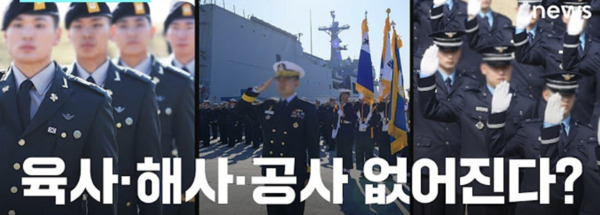
During my studies in political science at the State University of New York at Stony Brook, where I took courses such as U.S. Military History, American Foreign Policy and National Security, and The Politics of the Nuclear Age, I learned one clear lesson: strong nations do not fear their military. They control it—while also respecting it. The United States is a representative example.
This principle manifests itself both in institutions and in individual lives. Henry Kissinger, born into a poor German-Jewish immigrant family, entered the City University of New York while working to support himself. World War II changed the course of his life. He enlisted in the U.S. Army, beginning as a German interpreter and later distinguishing himself in counterintelligence and intelligence operations. After the war, he attended Harvard University under the GI Bill, where he studied political science and rose to become a global strategist—serving as a Harvard professor, Special Assistant to the President, and U.S. Secretary of State during the Cold War. This transformation cannot be explained by individual ability alone; it was made possible by a national system that linked military service to social mobility.
In the United States, military service is not a rupture but an expansion. The state supports it institutionally, and society respects it. Military experience does not interrupt a career; it opens new pathways.
Yet this respect is never synonymous with neglect. The core of the U.S. military system lies in what can be described as “integration built upon precise separation.” The United States Military Academy, United States Naval Academy, and United States Air Force Academy remain distinct to the end. This is because the Army, Navy, and Air Force fight fundamentally different wars. Their operational environments, modes of thinking, and command structures differ. To merge them prematurely is not to gain efficiency, but to risk the collapse of identity.
This does not mean that the United States abandons jointness—quite the opposite. At the academy level, identity and specialization are strictly separated. Above that level, operations are integrated through the joint chiefs system and advanced military education. Separation below, integration above—that is the method of a military power. Control and respect operate simultaneously within this structure.
This model offers even more direct implications for the Republic of Korea, a divided nation still technically at war. The conflict has not ended; it has merely been suspended. The distinctions among land, sea, and air domains are not functional differences—they define entirely different modes of warfare. In such a reality, the benchmark for military reform is not efficiency, but combat power.
Despite this, calls for integrating military academies continue to recur. The rationale may appear reasonable. But strengthening jointness does not require complete integration. On the contrary, premature integration risks weakening specialization and undermining combat effectiveness. The military is not a university. It is not a space for diversity and exchange, but an organization built on extreme specialization for survival and victory.
The persistence of such ideas also has a clear cause. The progressive camp in South Korea, many of whom emerged from anti-regime movements during past military governments, has already become part of the political establishment. Yet a lingering perception remains that the military is a potential rival center of power. What began as a reaction against past military rule is now extending into attempts to weaken the structure of the military itself—applying the logic of “decentralization” and “dismantling” used for other state institutions.
However, when institutional good intentions override professional expertise, systems collapse. We have seen this pattern in multiple sectors. The military is not immune.
The conclusion is clear. The military must be controlled. But its professionalism must also be guaranteed. A military without control is dangerous; a military without respect is ineffective.
The solution does not lie in a binary choice. The identity and foundational training of each service branch should remain strictly separate, while joint curricula, combined exercises, and exchange programs should be significantly expanded. Redundant administrative and support functions can be selectively integrated.
For a divided nation, the military is not an option—it is a necessity. Reform that weakens the military is not reform; it is risk. What is needed now is not symbolic integration, but a clear-eyed structure that enhances combat power.
#MilitaryReform #CombatReadiness #NationalSecurity