
522 읽음
Do Kim Boo-kyum, Jeon Jae-soo, and Jeong Won-oh Support the ‘Prosecution Cancellation Special Counsel Act’?
 최보식의언론
 0
0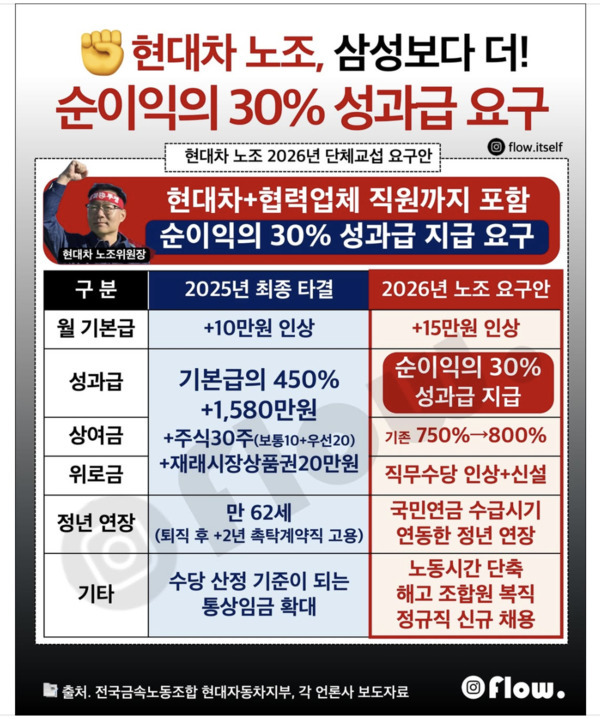
Recently, the FOMO (fear of missing out) phenomenon sweeping our society has extended beyond the stock and real estate markets to engulf labor-management relations in industrial workplaces.
A vague comparison mentality—“If others are getting this much, we should too”—has now been given institutional wings through the so-called “Yellow Envelope Act,” pushing South Korea toward becoming a “strike heaven.” It is time to soberly confront the reality that indiscriminate labor actions, hidden behind the justification of protecting rights, are choking the lifeblood of our economy.
The most representative example of labor FOMO is the recent controversy over performance bonuses at large corporations. It is entirely natural for global companies like Samsung Electronics or SK hynix to determine bonus levels based on business conditions and performance. The real problem arises afterward. Affiliates with no comparable performance, and even subcontractors unrelated to core production processes, are now demanding, “If we don’t get as much as they do, we will stop working,” using strikes as leverage.
This reflects a distorted logic in which wages are determined not by the value of labor or performance-based distribution, but solely by comparison with others. Such demands, made without regard to a company’s ability to pay, ultimately weaken financial structures and erode funds needed for future R&D—amounting to economic self-harm.
Even more alarming is that this comparison-driven mindset is spreading indiscriminately beyond production lines into essential support functions of corporate operations.
Recently, in some large companies, cafeteria workers and in-house welfare staff have halted services, demanding benefits and bonuses equal to those of primary employees. Even commuter bus unions and in-house logistics unions—critical to daily operations—have refused to operate, swept up in FOMO after hearing that subcontractors at other sites secured better deals.
These actions effectively hold entire industrial ecosystems hostage by paralyzing not only core operations but also basic support services. The self-centered mindset of “I cannot be the only one losing out” is normalizing a culture of constant struggle, even at the expense of colleagues’ meals and daily commutes.
The “Yellow Envelope Act” has only added fuel to the fire. By ambiguously expanding the definition of “employer,” it has made it seem natural for subcontractor unions to occupy primary business sites and demand direct negotiations. For parent companies, this creates a constant risk of operational paralysis due to excessive demands from workers they do not directly employ.
News that “another union pressured the parent company and secured gains” spreads FOMO rapidly across the labor sector. The fear of “being left behind” drives a strike-first mentality, replacing rational dialogue. In the process, South Korea’s intricate and highly integrated industrial supply chains are being torn apart.
The global market is unforgiving. While the world is engaged in a fierce race for AI and advanced technology dominance, South Korea is mired in outdated labor conflicts. Who would invest in a country where strikes are constant and legal stability is eroding? If this continues, South Korea risks becoming an “investment-avoidance nation.”
Many manufacturing firms are already accelerating automation and robotics to avoid labor risks or relocating production overseas altogether. This is not merely capital flight—it is a national crisis that eliminates quality jobs for young people.
If labor continues to fixate only on short-term comparative gains, South Korea could soon become an “industrial graveyard” erased from the global economic map.
Workers’ rights must be respected. But they should not extend to threatening the survival of entire industries. Bonuses and benefits gained at the cost of a company’s collapse are meaningless. Without viable companies, there can be no worker welfare.
The government must firmly uphold law and order against illegal and indiscriminate strikes and restore discipline in the field. In particular, toxic provisions of the “Yellow Envelope Act” must be urgently revised before causing further disruption.
Labor must also recognize that excessive strike actions will ultimately destroy their own workplaces. Unless this destructive cycle ends, South Korea will fall behind in global competition, and its industrial future will move beyond decline toward extinction.
Watching these troubling scenes unfold in our industrial sector, one can almost hear the laughter from Taiwan, China, and Japan.
#FOMO #LaborDisputes #KoreanEconomy