
1,324 읽음
트럼프 이란 공격 2주 유예, 호르무즈 개방 조건
 최보식의언론
 0
0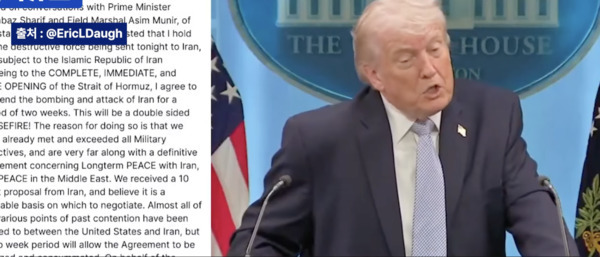
This decision was influenced in part by a phone call with Shehbaz Sharif, Prime Minister of Pakistan. By utilizing a mediation channel, Trump created a potential exit while preserving the military option intact. He claimed that Iran had submitted a ten-point proposal and that an agreement was within reach, yet disclosed no details. This suggests not progress in negotiation, but an attempt to dominate the negotiation environment itself.
The two-week period is not a ceasefire. It is a test phase combining time pressure with conditional concession. The benchmark is clear: whether the Strait of Hormuz is reopened. If it is, negotiations proceed to the next stage; if not, military action can resume at any moment. This is a classic deadline tactic designed to induce compliance.
Iran’s response can also be understood through the lens of negotiation theory. Full acceptance risks regime collapse, while outright rejection invites destruction. The remaining option is partial compliance—buying time while keeping negotiations alive. This aligns with the management of BATNA (Best Alternative to a Negotiated Agreement). Iran is choosing limited concessions to avoid a catastrophic alternative.
Trump’s approach operates within the same framework. By invoking even the possibility of nuclear use, he elevates his own BATNA to an extreme level. The message is clear: if negotiations fail, the consequences will be unbearable. This combines anchoring with credible threat—setting an extreme starting point to pull the entire negotiation structure in his favor.
The problem is that this strategy sharply narrows the Zone of Possible Agreement (ZOPA). Negotiation exists where interests overlap. However, pressure that includes even the implicit possibility of nuclear escalation constrains the opponent’s options to the point where the negotiation space itself begins to collapse. Trump’s reference to “the destruction of an entire civilization” is not mere rhetoric. It is the explicit presentation of a catastrophic BATNA—something typically considered taboo in negotiation. While such a move may strengthen leverage if perceived as credible, it simultaneously amplifies uncontrollable risk.
From here, three paths are possible: Iran partially reopens the Strait and negotiations continue; both sides move toward a comprehensive agreement based on the ten-point framework; or Iran refuses, leading to renewed military confrontation. In the last scenario, negotiation collapses and BATNA becomes reality. At that point, the nuclear option is no longer hypothetical—it becomes a choice.
These two weeks are not peace. They are a decisive window for restructuring the negotiation framework. Negotiation is not a technique of subjugation, but a process of creating a new order. Yet when BATNAs converge toward conflict and ZOPA disappears, negotiation ends. What Trump is testing is not the art of negotiation, but its limits. And once that limit is crossed, negotiation vanishes—leaving only power to determine order.
#NegotiationOrCoercion #TrumpIranCrisis #BrinkmanshipDiplomacy