

 최보식의언론
•
Nvidia’s New Political Reality: Implications for Samsung and SK Hynix
파워링크 AD 
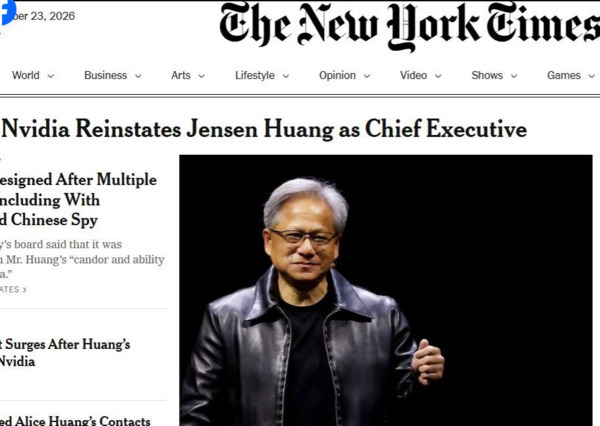
Wall Street cheered the surge in share prices, declaring that uncertainty had been lifted. But South Korea’s semiconductor industry cannot afford to view these developments lightly. As Nvidia, which sits at the pinnacle of the global AI semiconductor ecosystem, has survived thanks to a political lifeline from Washington, Samsung Electronics and SK Hynix now face both a crisis and a paradoxical opportunity.
The immediate threat is that Nvidia, politically indebted to the White House, could become an instrument of national policy and pass its costs on to suppliers. Having regained his position under the direct protection of President Donald Trump, Jensen Huang will find it difficult to reject future demands for expanded manufacturing and packaging investment in the United States and tighter export controls on China.
As a fabless semiconductor company without its own manufacturing facilities, Nvidia will inevitably have to squeeze its supply chain partners to pay this political bill while protecting its profitability.
There is a significant risk that Nvidia will not only pressure Samsung Electronics and SK Hynix, its suppliers of high-bandwidth memory (HBM), as well as Samsung’s foundry business and South Korean materials, components and equipment companies, to expand U.S. fab operations and make additional investments, but also pass on the higher costs of U.S. production arising from uncertainties surrounding tariffs and subsidies.
It is also likely to exploit the competitive dynamics between the two South Korean companies to impose steep price cuts and secure more favorable supply terms.
Beyond the crisis, however, an enormous opportunity is emerging—one that had previously been obscured by Nvidia’s overwhelming monopoly.
In the global business-to-business market, supply contracts worth tens of billions of dollars cannot be sustained by chip processing speeds alone. They must be underpinned by trust in the transparency and predictability of business partners’ corporate governance.
The spectacle of Nvidia’s board abandoning its principles over the fate of a single founder and a phone call from the president, even before an internal investigation was completed, has given global technology giants such as Google, Amazon, Microsoft and Meta—already frustrated by Nvidia’s monopolistic pricing power—further justification to reduce their dependence on Nvidia and accelerate the mass production of their own customized AI chips, known as application-specific integrated circuits (ASICs).
As the AI chip ecosystem shifts from Nvidia’s dominance toward a multipolar structure in which Big Tech companies pursue their own strategies, the balance of bargaining power will tilt toward South Korean semiconductor companies.
The more Big Tech companies expand their use of proprietary AI chips, the more urgently they will need partners equipped with next-generation custom HBM and advanced manufacturing capabilities tailored to those chips.
Breaking away from vertical dependence on Nvidia as a single customer, Samsung Electronics can leverage its turnkey capabilities encompassing foundry services, memory and packaging, while SK Hynix can capitalize on its strong AI partnership with TSMC and its overwhelming technological strength in custom HBM.
Both companies now have a foundation on which to forge new relationships with Big Tech. It is a prime opportunity to transform their bargaining position from subordinate suppliers into indispensable strategic partners.
The challenge that Jensen Huang’s return presents to South Korea is clear.
South Korean semiconductor companies must respond calmly and firmly to short-term pricing and investment pressures arising from Nvidia’s political dependence, while exploiting the structural cracks created by Big Tech’s rush to reduce its reliance on Nvidia. They must diversify their customer bases and secure leadership in next-generation HBM4 technology.
The South Korean government, for its part, must not leave the burden of negotiations entirely to individual companies. It should mobilize all available South Korea–U.S. trade and security channels to ensure that promises of subsidies for investment in the United States are honored and that exemptions from export controls for South Korean companies’ manufacturing facilities in China are maintained.
Only when proprietary technology moats that prevent companies from being held hostage by any single customer are combined with sophisticated trade diplomacy can South Korea turn the bill of uncertainty coming from Washington into an asset of opportunity.
jinannkim@gmail.com
#Nvidia #SouthKorea #SemiconductorIndustry
* This article has been translated by ChatGPT.
최보식의언론 콘텐츠 더 보기
South Korea Offers $100,000 to Report Exam Cheaters. But at What Cost?
최보식의언론

South Korea’s $100,000 Cheating Reward Sparks Debate Over Surveillance
최보식의언론

Jensen Huang’s Return: What’s at Stake for Samsung and SK Hynix?
최보식의언론
반도체 AI 투자 병목, 재고관리와 속도조절 강조
최보식의언론
젠슨 황 엔비디아 CEO 사퇴, 족벌 경영 및 실뢰 상실
최보식의언론